




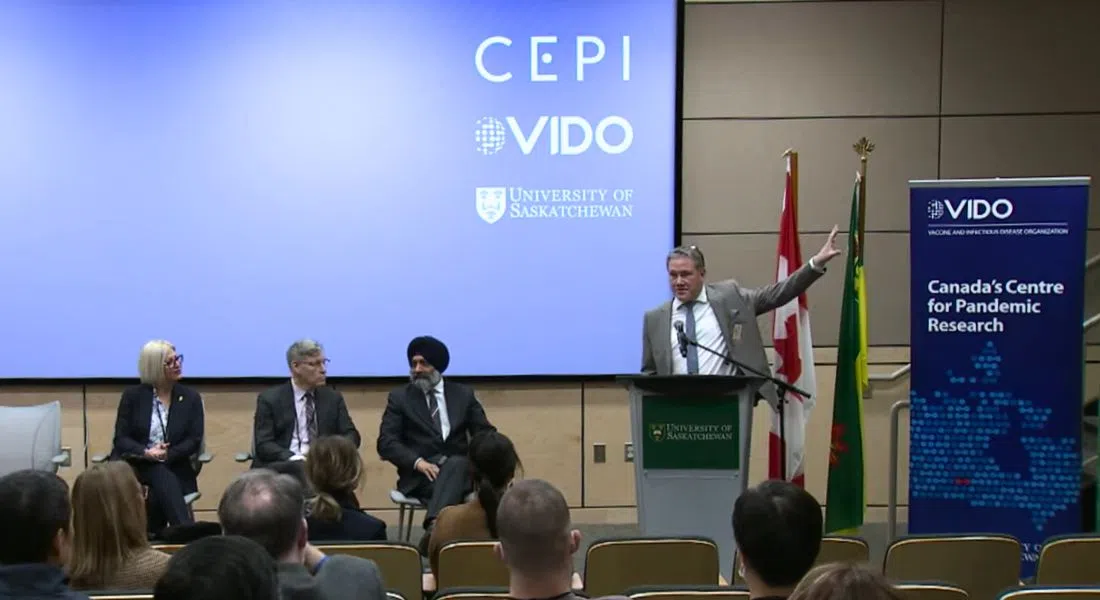
It’s a good day for VIDO. That’s according to its Director and CEO, Dr. Volker Gerdts as $24 million in funding from one of the world’s largest organizations that focuses on new diseases was announced at VIDO’s home on USask’s campus.
The Executive Director of the Coalition for Epidemic Preparedness Innovations, or CEPI says the funding is to advance global health and disease prevention. More specifically, it’s for VIDO to continue is work on developing a vaccine which could protect against different types of coronaviruses. Dr. Nicole Lurie says, “If it’s successful, this vaccine could kind of serve as a holy grail, protecting us against both the coronaviruses we know about and the ones that could still strike in the future. This could help stop a future outbreak in its tracks before it spreads to pandemic proportions.” The project builds on VIDO’s earlier work on a variant-proof COVID-19 vaccine, which received funding from CEPI in 2021. Dr. Lurie explains that an advantage of this vaccine is that it doesn’t need complex frozen storage. It is thermostable, which means it would be more accessible.
Dr. Gerdts says VIDO is about predicting what the future threats are, developing vaccines or therapeutics for these threats today and making sure Canada in the future is better protected, whether it’s an animal or human disease.
The provincial government has also supported VIDO. In this fiscal year over $4 million was funded for annual operating costs and in 2021, $15 million was announced to help build and expand the facility.
The Minister Responsible for PrairiesCan notes that the federal government had previously funded CEPI $100 million to advance vaccine research and support equal access globally. Since 2020, the Government of Canada has invested over $120 million to VIDO to become a world-class hub for research, innovation, and vaccine manufacturing. Terry Duguid says VIDO’s partnership with CEPI is testament to its growing reputation as a global leader in protecting against future pandemics.
He then switched gears to talk about the possibility of tariffs from the United States, stating that Saskatchewan’s two-way trade with the U.S. accounts for 28.5 per cent of the province’s economy. In 2023, Saskatchewan businesses exported almost $30 billion worth of goods south of the border. He states that if the U.S. government moves forward with this tariffs, the federal government will do what is best for Canada and Canadians, defending the country’s interests and standing up for Canada.