




The latest Saskatchewan Agriculture crop reports puts provincial harvest progress at 12 per cent—below the five-year and ten-year averages.
Thunderstorms delayed harvest operations in some areas, while others wait for crops to mature. The southeast has the most combined at 23 per cent, followed by the southeast at 14 per cent. The east-central region (11 per cent), west-central (6 per cent), northeast (3 per cent) and northwest (2 per cent) round out provincial progress.
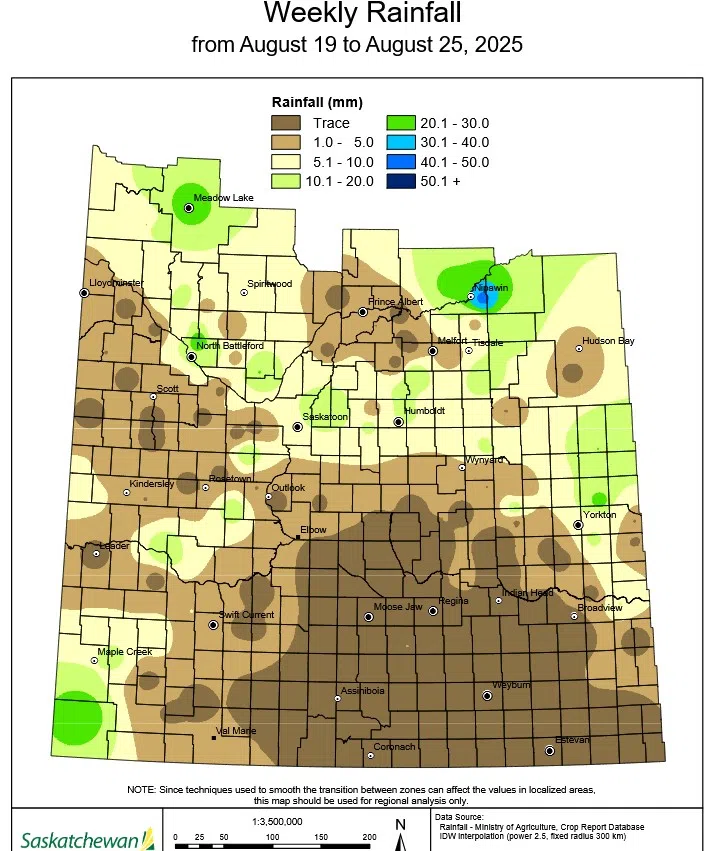
The Nipawin area in the northeast had the most rain with 42 millimetres with North Battleford receiving 30 millimetres. Extension specialist Tyce Masich says there were some harvest delays, but other regions were able to continue.
Crop reporters were asked to assess the winter wheat crop. Provincially, it was rated 23 per cent 1CW, 65 per cent 2CW, 11 per cent 3CW and one per cent feed. Those numbers are below the ten-year average.
Masich reports late season insect issues were reported in some areas.
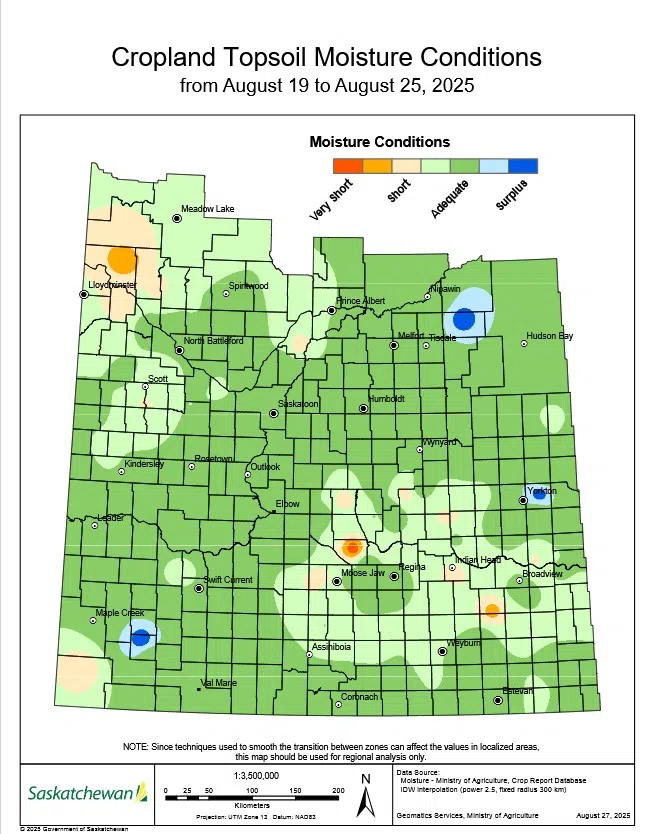
Despite some rain, provincial topsoil moisture levels fell slightly last week, but conditions remain high relative to earlier this growing season. Cropland topsoil moisture levels are three per cent surplus, 77 per cent adequate, 18 per cent short and two per cent very short. Pasture topsoil moisture conditions are three per cent surplus, 60 per cent adequate, 31 per cent short and six per cent very short.
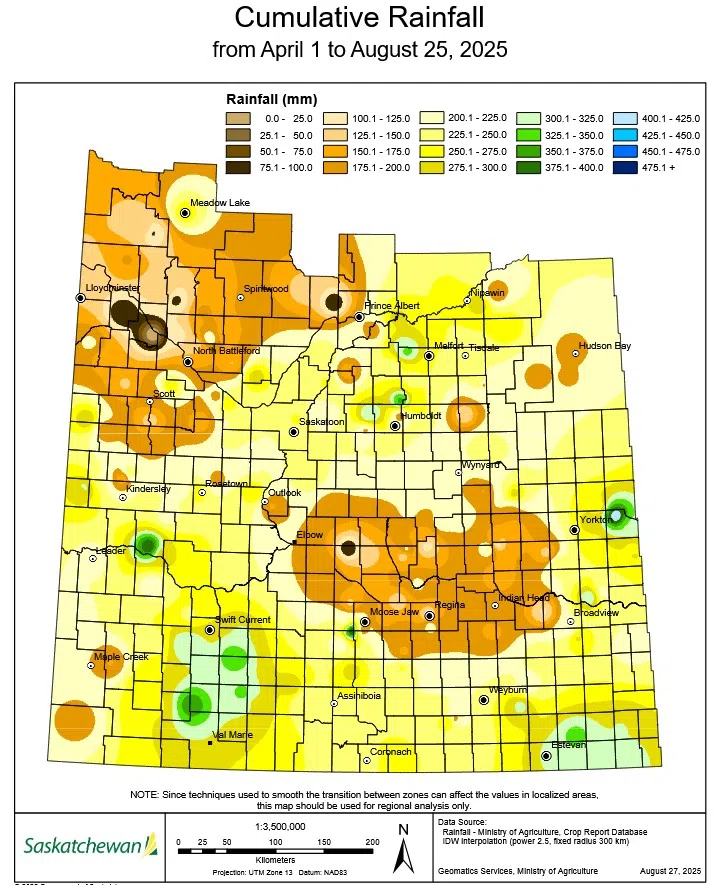
The full region-by-region crop is below along with the various maps and charts.
SOUTHEAST
Carnduff, Estevan, Lampman, Redvers and Stoughton areas
Avonlea, Fillmore, Minton, Radville and Weyburn areas
Broadview, Esterhazy, Melville and Moosomin areas
Belle Plaine, Cupar, Lumsden, Indian Head, Regina and Rouleau areas
Harvest is in full swing for most producers in the southeast due to warm and dry conditions last week. Harvest is 14 per cent complete in the southeast, which is up 10 per cent from last week. Producers were combining winter cereals, pulses and spring wheat crops last week. In addition to combining, producers are also desiccating and swathing crops.
Approximately two-thirds of winter cereal crops are off with 70 per cent of fall rye and 65 per cent of winter wheat harvested. Producers are in the middle of harvesting pulses as 59 per cent of the field pea and 53 per cent of the lentil acres have been combined, while chickpeas lag behind the other pulses with only 16 per cent of these crops harvested. More producers started harvesting spring cereal crops last week. Harvest progress for barley sits at 18 per cent, 15 per cent for both durum and oats, and seven per cent for spring wheat. Oilseed crops aren’t ready for harvest yet as essentially none of these crops have been combined. All reported triticale crops were harvested as feed this year.
The southeast has some of the best quality winter wheat and fall rye crops in the province this year. Currently, winter wheat is graded as 42 per cent 1 Canada Western (CW), 51 per cent 2 CW, six per cent 3 CW, and one per cent CW feed. For fall rye, 64 per cent is 1 CW, 34 per cent is 2 CW and two per cent is 3 CW.
There was very little rain in the southeast last week. The only places to get any notable rain was the Saltcoats area with 11 millimetres (mm) and the Rocanville and Langenburg areas with 10 mm each. With very limited rain, topsoil moisture levels slightly decreased. Cropland topsoil moisture levels are one per cent surplus, 74 per cent adequate, 21 per cent short and four per cent very short. Hayland topsoil moisture is 63 per cent adequate, 34 per cent short and three per cent very short. Finally, pasture topsoil moisture is 57 per cent adequate, 35 per cent short and eight per cent very short.
Most pastures in the southeast are in fair to good condition. One per cent of pastures are excellent, 57 per cent are good, 29 per cent are fair, 12 per cent are poor and one per cent are in very poor condition.
Most crop damage reported was caused by hot temperatures, dry conditions and strong wind that lodged crops, but damage was not widespread in the region. A couple of locations received hail which caused varying levels of crop damage.
SOUTHWEST
Assiniboia, Gravelbourg, Mankota, Ponteix and Rockglen areas
Cadillac, Consul, Eastend, Maple Creek and Val Marie areas
Beechy, Central Butte, Craik, Herbert, Hodgeville and Moose Jaw areas
Cabri, Elrose, Fox Valley, Leader, Swift Current and Tompkins areas
It was another dry week for most of the southwest, which producers welcomed to help crops mature and harvest without delays. Harvest in this region is leading the province with 23 per cent complete, but producers are noting that crop regrowth and weed emergence from previous wet conditions is complicating harvest efforts.
Harvest of winter cereal crops is winding down with 94 per cent of winter wheat and 93 per cent of fall rye off. Significant portions of field pea and lentil crops have been harvested as well, with progress sitting at 59 per cent for field peas and 40 per cent for lentils. Most chickpea crops are still in the field with only seven per cent of these crops in the bin. Producers are also making steady progress harvesting spring cereal crops. Currently, 45 per cent of triticale, 35 per cent of barley, 20 per cent of oats, 16 per cent of durum, 15 per cent of spring wheat and 13 per cent of canary seed have been harvested. Finally, early seeded canola crops are starting to be combined with progress sitting at seven per cent.
Winter wheat and fall rye grades vary in the southwest. Winter wheat is graded as nine per cent 1 Canada Western (CW), 36 per cent 2 CW, 48 per cent 3 CW and seven per cent CW Feed. For fall rye, 26 per cent is 1 CW, 46 per cent is 2 CW and 28 per cent is 3 CW.
Many parts of the southwest did not receive rain last week but there were some sporadic showers. The Consul area had the highest rainfall with 28 millimetres (mm), followed by the Kyle area with 18 mm and the Piapot area with 11 mm. Despite limited rainfall, topsoil moisture remains high in most of the southwest. Cropland topsoil moisture is rated at three per cent surplus, 85 per cent adequate, 10 per cent short and two per cent very short. For hayland, topsoil moisture is four per cent surplus, 69 per cent adequate, 23 per cent short and four per cent very short. Similarly, topsoil moisture for pastures is six per cent surplus, 69 per cent adequate, 22 per cent short and three per cent very short.
Most pasture conditions in the southwest vary from fair to excellent. Currently, 14 per cent are in excellent condition, 46 per cent are good, 31 per cent are fair, eight per cent are poor and only one per cent are in very poor condition.
WEST CENTRAL
Biggar, Delisle, Rosetown and Sonningdale areas
Cut Knife, Kerrobert, Kindersley, Macklin, Plenty and Wilkie areas
Producers are just starting to harvest crops in the west-central region, with several still waiting to start. This is reflected in the harvest progress total which is only six per cent complete. As harvest is starting, producers are also swathing and desiccating crops.
Of the crops that have been harvested, most progress has been made in winter cereals. All winter wheat and 32 per cent of fall rye crops have been harvested. Producers are in the midst of harvesting pulse crops as 22 per cent of field peas and 16 per cent of lentils have been combined. Not many spring cereal crops have been combined yet, but 25 per cent of triticale and 15 per cent of oat crops have been harvested as feed.
All reported winter wheat graded in the two highest categories. Twenty-five per cent of winter wheat was graded as 1 Canada Western (CW) and 75 per cent as 2 CW. For fall rye, 75 per cent was graded as 2 CW and 25 per cent as 3 CW.
There was some sporadic rainfall in the west-central region last week. The Harris area had the most precipitation with 15 mm, followed by the Milden area with 14 mm. Lots of the region was dry last week, which caused soil moisture levels to slightly drop. Currently, cropland topsoil moisture is 75 per cent adequate and 25 per cent short. For hayland, topsoil moisture is 68 per cent adequate and 32 per cent short. For pastures, topsoil moisture is rated as 67 per cent adequate, 32 per cent short and one per cent very short.
In general, most pastures are in fair to good shape. Conditions are 46 per cent good, 50 per cent fair and only four per cent poor.
Very little crop damage was reported last week. Bertha armyworm and grasshopper activity damaged a few crops, but damage was not widespread.
EAST CENTRAL
Calder, Canora, Pelly, Preeceville, Sheho and Yorkton areas
Foam Lake, Kelliher, Leroy, Raymore and Wadena areas
Davidson, Colonsay, Langham, Lanigan, Nokomis, Outlook and Saskatoon areas
More producers are starting to harvest crops in the east-central, but showers and humid conditions have resulted in slow progress. Currently, harvest progress is at 11 per cent. On top of harvesting, producers continue to desiccate and swath crops as they mature.
Over half of the winter cereal crops have been harvested, with progress sitting at 57 per cent for winter wheat and 53 per cent for fall rye. Approximately one-third of pulse crops have been harvested, with progress sitting at 42 per cent for lentils and 33 per cent for field peas. Finally, early seeded cereal crops are starting to come off with 25 per cent of durum and 16 per cent of barley harvested.
Similar to the southeast, the east-central region has some of the highest winter cereal grades. Winter wheat is currently graded as 37 per cent 1 Canada Western (CW) and 63 per cent 2 CW. Fall rye is graded as 56 per cent 1 CW, 38 per cent 2 CW and six per cent 3 CW.
There was variable rainfall in the east-central region last week, with Canora receiving 24 millimetres (mm), followed by the Danbury area with 20 mm, and Pelly area with 17 mm. There was not enough rainfall to prevent soil moisture from decreasing over the last week. Cropland topsoil moisture is five per cent surplus, 77 per cent adequate, 14 per cent short and four per cent very short. Hayland topsoil moisture is six per cent surplus, 66 per cent adequate, 24 per cent short and four per cent very short. Finally, pasture topsoil moisture is rated as six per cent surplus, 40 per cent adequate, 45 per cent short and nine per cent very short.
Many pastures in the east-central area are in fair condition. Currently, one per cent of pastures are in excellent condition, 33 per cent are good, 51 per cent are fair and 15 per cent are poor. Producers would like to see some rain after harvest to help improve pasture conditions for next year.
There was no widespread damage in the east-central region last week, but some isolated reports of crop damage were caused by various factors. Producers are noting water accumulated in low spots is damaging crops in some areas. Producers are also noting wind, hot temperatures and dry conditions are also having a minor impact on crops in certain areas.
Bertha armyworms are continuing to cause varying levels of damage in some canola crops as well. A few reporters are seeing minor wildlife and waterfowl feeding on crops.
NORTHEAST
Choiceland, Hudson Bay, Kelvington, Melfort, and Nipawin areas
Cudworth, Humboldt, Kinistino, Prince Albert, Rosthern and St. Brieux areas
In the northeast region, early seeded crops are starting to be combined, but harvest progress sits at three per cent. Producers are busy spraying crops, swathing and preparing equipment for harvest.
The only crops that have been taken off so far are winter cereals, pulses and barley. Eighty-nine per cent of fall rye and 51 per cent of winter wheat are in the bin. For other crops, 19 per cent of field peas and nine per cent of lentils and barley have been harvested.
Most winter wheat and fall rye crops have graded in the 2 Canada Western (CW) category. For fall rye, three per cent is 1 CW, 90 per cent is 2 CW, four per cent is 3 CW and three per cent is sample. All winter wheat reported in the northeast graded as 2 CW.
Rainfall was variable in the northeast last week. The Nipawin area received the most rain with 42 mm, followed by Torch River with 23 mm, and Aberdeen with 18 mm. With the modest rainfall, topsoil moisture remains similar to last week. For cropland, topsoil moisture is seven per cent surplus, 86 per cent adequate and seven per cent short. Hayland topsoil moisture is seven per cent surplus, 83 per cent adequate and 10 per cent short. Finally, pasture topsoil moisture is four per cent surplus, 84 per cent adequate and 12 per cent short.
Pastures in the northeast are some of the best quality in the province. Currently, 13 per cent of pastures are in excellent condition, 54 per cent are good, 26 per cent are fair and only seven per cent are poor.
Parts of the northeast experienced thunderstorms last week which brought strong winds and hail. There was minor to moderate damage in some crops that experienced these conditions. Additionally, bertha armyworms continue to be a concern in parts of the northeast as producers continue to spray canola crops.
NORTHWEST
Blaine Lake, Canwood, North Battleford, Radisson and Spiritwood areas
Glaslyn, Maidstone, Meadow Lake, Pierceland and St. Walburg areas
Harvest is slowly getting underway for some producers as many crops are not quite ready for harvest. Only two per cent of crops in the northwest have been harvested, most of which are winter wheat and pulses. Half of the winter wheat crops have been harvested, while harvest progress for field peas and lentils is reported at 20 per cent and 10 per cent, respectively. Some spring wheat and barley fields are being opened up, but progress in these crops is minimal so far. There are no fall cereal crops to report for the northwest.
Like the northeast, there was modest rainfall in the northwest. The North Battleford area received the most rain with 30 millimetres (mm), followed closely by the Meadow Lake area with 27 mm and Hafford area with 20 mm. Soil moisture levels dropped slightly from last week. Cropland topsoil moisture is now rated as one per cent surplus, 65 per cent adequate, 29 per cent short and five per cent very short. For hayland areas, topsoil moisture is 45 per cent adequate, 41 per cent short and 14 per cent very short. Finally, pasture topsoil moisture is 45 per cent adequate, 41 per cent short and 14 per cent very short.
Pasture conditions vary in the region. Two per cent are in excellent condition, 19 per cent are good, 43 per cent are fair, 26 per cent are poor and 10 per cent are very poor.
Most crop damage reported was from dry conditions, hail, and heavy winds. Some fields experienced varying levels of bertha armyworm and grasshopper damage as well. Despite damage being reported, it was not widespread in the region.