



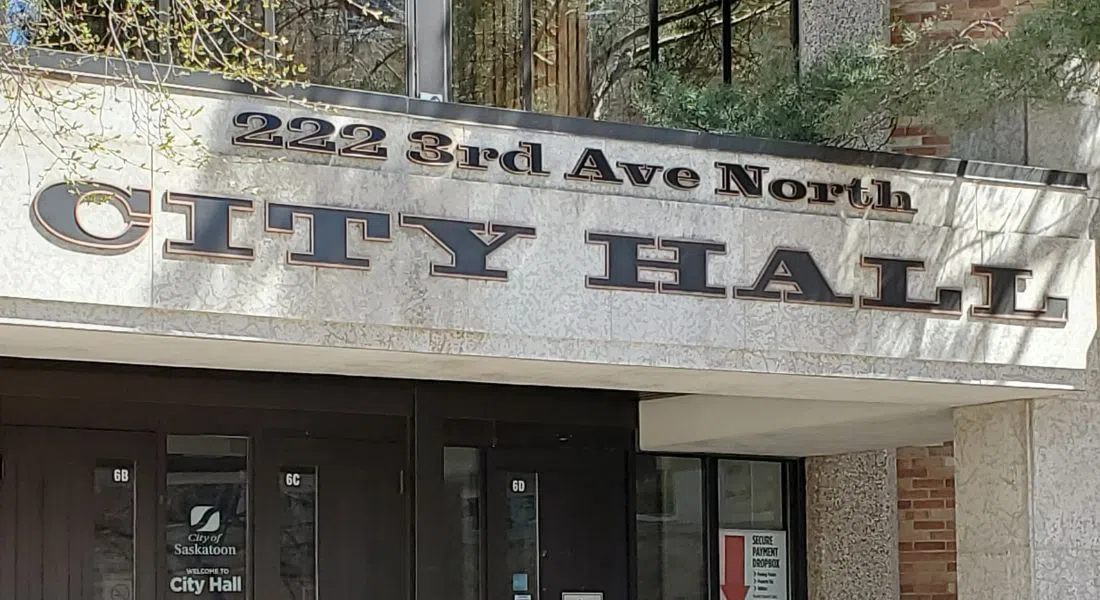
As of 5:00 p.m. Thursday, Saskatoon City Council has narrowed the proposed property tax increases for 2026 and 2027 down to 6.17 and 5.39, respectively. These figures are down from 6.43 and 5.95 per cent that existed at the start of the day.
Council saved $121,000 right out of the gate Thursday morning by exempting miscellaneous civic properties from paying storm water management charges.
They saved an additional $108,200 over two years by pulling City funding from the detox unit on Avenue O South. The facility is run by the Saskatchewan Health Authority, and therefore Councilor Troy Davies thinks the province should fund it fully, among other reasons.
“I have zero problems with the City stopping funding on this, because there are other options going on. I think now it’s more of an alcohol detox centre more than opioid crisis for anyone who’s overdosing. I think it was a good thing to invest in at the time, but now it’s time to move on.”
Council also asked Administration to report back on both the impacts of cutting the youth sports subsidy and reducing the cash grant program for social servicing agencies.
Next, councilors peered into the recreation budget to see where potential savings can be made to lower the mill rate. The group voted in favour of increasing rental rates at indoor arenas over two years. This would generate $138,000 in 2026 and $132,000 in 2027. Administration’s report noted this option could come with several risks, including a reduction in admission volumes and negative impacts on accessibility and affordability of recreation programs.
However, an option to increase daily admission rates at outdoor pools by $1.50 to match indoor pools was defeated. Councilor Robert Pearce was one of the many who opposed it.
“When I see the kids lining up to get into that pool, and I see the families lining up to get into that pool, and I know in that area cost is a potential barrier, that $1.50 may not mean a lot to us, but it could mean something to that family.”
The options to close George Ward Pool, close two outdoor pools for the month of June, reduce pool operating hours by one hour per day, and reduce youth centre programming weren’t moved when no councilor voted to open the discussion.
The cost for Saskatoon residents to license their pets is going up as a result of other budget amendments.
Council voted in favour of raising license fees by 2.5 per cent in both 2026 and 2027. This will generate a total of $47,000. Councilors Pearce and Ford opposed it.
Council also approved the establishment of a ‘golf courses ROI’. This would consist of an estimated 5 per cent added to green fees and driving range fees over the next two years. Councilor Randy Donauer was exceptionally opposed.
“Most of the other programs we’ve talked about today actually get mill rate-funded support or subsidization or some sort of a grant. The golf courses get none, so for us to turn around and say, ‘In addition to getting no mill rate funding and not getting a grant to operate, now we just want to make money off of you.’ I can’t support that.”
A vote to increase rates and fees for mill- rate supported City facilities such as rinks, pools, and the Zoo failed with 7 councilors opposed, however, non-resident swimming lesson fees are going up in 2027.
People from outside the city seeking swimming lessons will be dealt with a 50 per cent surcharge. Director of Recreation Andrew Roberts estimated that the non-resident surcharge would result in a 15 per cent reduction in sales. However, he explains “in relation to swimming lessons, we are currently in a situation where we are oversubscribed, so if we were to implement this and did see a reduction in nonresident usage, that would get taken up by residents that are currently facing challenges getting in.”
Council also voted in favour of reducing hours at all Indoor Leisure Centers by a half-hour per day. Estimated savings for this option will be $176,050. Council didn’t bite on the chances to reduce expressway mowing, eliminate fall litter pickup, reduce park turf mowing, extend the tree pruning cycle, reduce tree planting, and reduce berm mowing.
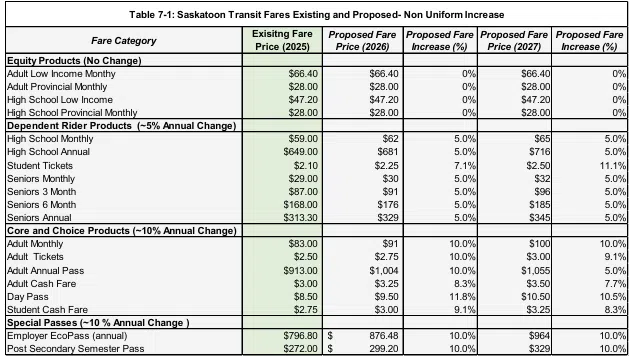
Under the transportation file, certain transit fare rates will be increasing in 2026 and 2027.
The reform comes as Saskatoon Transit fares have been stagnant since 2016, a quality unique to Saskatoon when compared to other Canadian cities. City Council voted in favour of Administration’s recommendation to increase Dependent Rider, Core/Choice Products, and Special passes by 5,10, and 10 per cent respectively, while leaving Equity Products alone.
Councilor Pearce motioned to keep Dependent rider fares at a zero per cent increase.
“I do know there’s a lot of families who have high school students…and seniors, many of them are on fixed income. I think if we could keep that at zero, (we should) for at least for 2026 and 2027 until the next review process comes up.”
However, he was shot down. To see if your rates are impacted, see the chart below.
After a lengthy discussion, Council voted against reducing transit service by one hour in the middle of the day on certain routes.
The option would have saved $832,000 over two years. Councilor Zach Jeffries says the City is trying to move toward a modern, reliable bus service, not the opposite.
On another note, an additional $44,600 will be generated through charging residents and business for false fire alarms. Administration says the false alarm charges would be geared to repeat offenders who fail to expedite repairs.
Another $66,400 was saved by establishing a costs recovery effort for emergency and safety services at the Fireworks Festival, Canada Day, and the Saskatoon Ex.
Without much discussion, Saskatoon City Council has approved the budgets for the Fire Department, land development, environment, utilities, transportation, urban planning and development, community support, recreation and culture, corporate asset management, corporate governance and finance.