



The Canadian Light Source in Saskatoon is once again being featured as a catalyst for groundbreaking research.
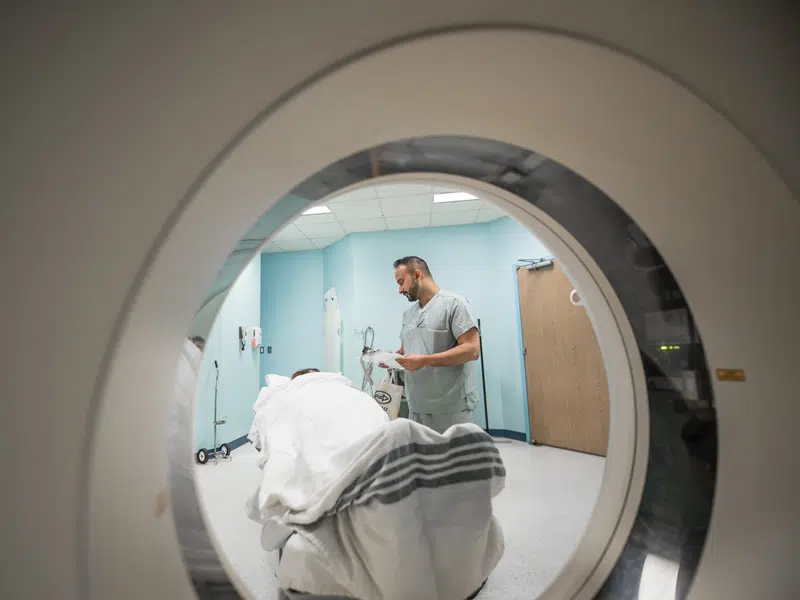
For the last three years, Dr. Tom Tiedje (TEE-jee) at the University of Victoria has been using the CLS to take a closer look at CT scanner machines.
He and his team of post-doctoral fellows are working on improving the ‘contact’, an ultra-thin layer of metal on top of the detector, by switching the contact material from an oxide to a sulfide.
“I had an idea about how we might be able to make the detectors work better, and I discussed this with management at Redlen Technologies. They liked the idea, so we wrote a proposal to Mitacs, and Mitacs funded it.”
He says the team also partnered with the CLS, which “allows us to probe the composition of the material that’s only one or two nanometers right between the metal and the semiconductor…The CLS has unique capability that we can’t do any other way, so it’s really a great resource for us.”
Tiedje (TEE-jee) says current CT scanners create 3D images of bones and soft tissues using computed tomography, but you can get a more detailed picture by utilizing something called photon counting computed tomography.
“What they do is they count the photons that come in. Each X-ray photon, if you measure it as it comes in, you can tell how big it is, and so then you can measure how the different photons come through the body tissue.”
This technology would differentiate different types of soft tissue, such as blood from muscle, for example.
“The method is more sensitive, so you can get a good image with a smaller number of photons. That means you can make the image with less radiation exposure to the patient.”
Tiedje adds that with this new technology, once rolled out on a large scale, will allow for more accurate and potentially earlier diagnoses. He says the group is working with Redlen Technologies, which plans to incorporate any improvements they come up with into their future products.