



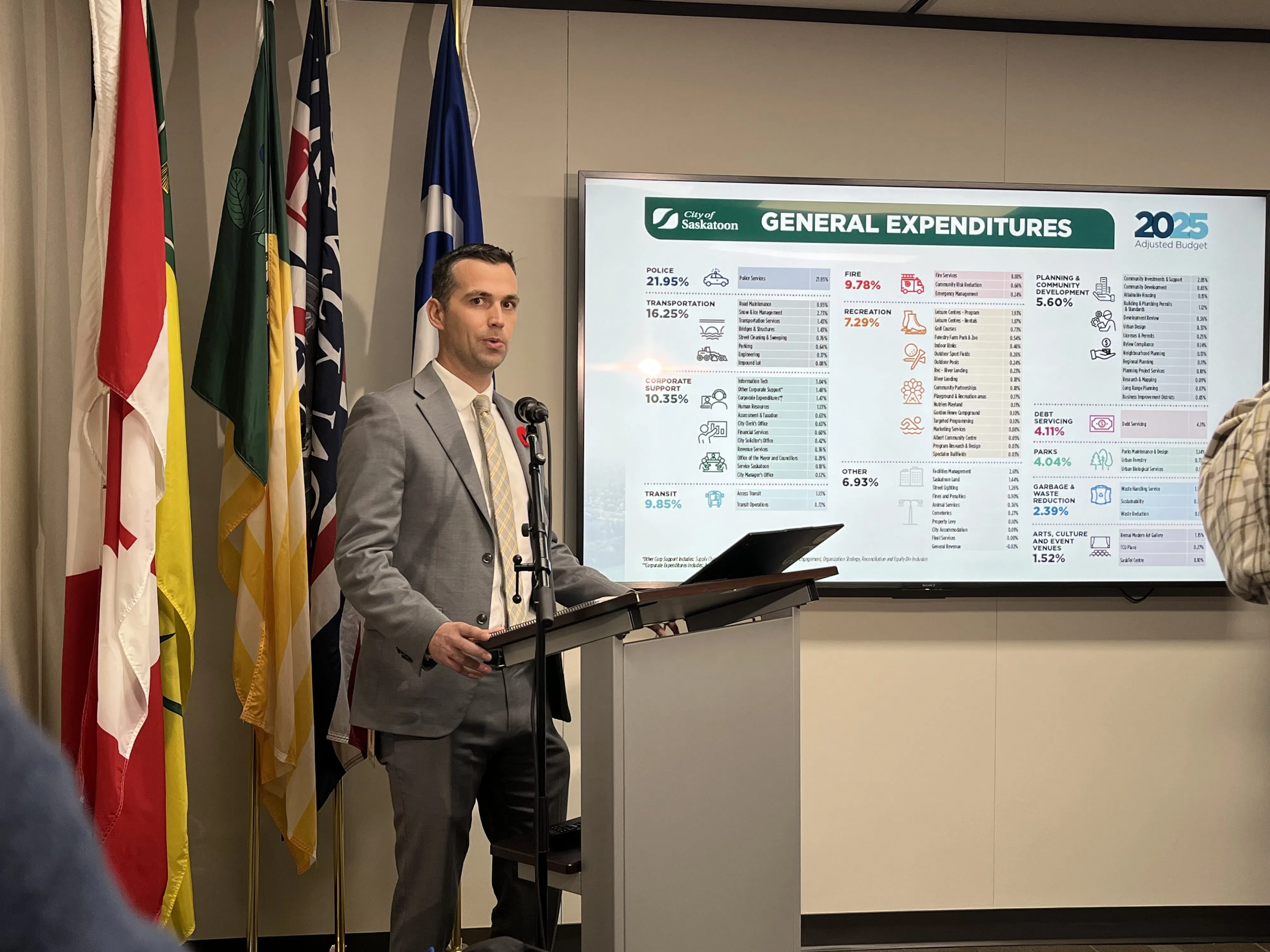
The City of Saskatoon has revealed its preliminary 2026-2027 Multi-year Business Plan and Budget.
The proposed property tax increase for a homeowner with an assessed home value of $394,200 will be 8.23 per cent in 2026 and 5.95 per cent in 2027. This equates to $16.20 more per month in 2026 and $12.67 more in 2027. These figures are down from what was projected in the 2026/27 financial forecast in June, which indicated hefty 10 and 7.3 per cent property tax increases over the next two years. Because municipal governments aren’t permitted to run operating deficits, the property tax is usually used as a tool to make up the difference.
Saskatoon’s Chief Financial Officer Clae Hack says the budget the City is presenting “is Administration’s viewpoint on the minimum cost to maintain services. We’ve done work already to trim it down. This is not Administration’s wish list budget.”
The City says increased spending in 2026-27 will account for inflationary pressures and population growth. Saskatoon grew by 33,000 people, or the size of Moose Jaw, between 2021 and 2024. The City expects that 9000 new residents moved here in 2025 alone.
To address this growth, the civic operating budget includes spending increases of $29.2 million in 2026 and $32.1 million in 2027. This excludes Saskatoon Police Service, Utilities, and Saskatoon Public Library spending. Total expenditures in 2026 total $1.7 billion: $1.21 billion in operating expenditures and $486,000 in capital expenditures. In 2027, total expenditures rack up to be $1.69 billion: $1.27 billion in the operating collum and 486,000 in capital spending.
Overall spending will be mainly focused on four key pillars: transportation, transit, public safety, and operations/community services. Investment highlights include $84.4 million and $89.4 million in 2026 and 2027 in transportation infrastructure. This includes resurfacing roadways, improving network reliability, and maintaining winter snow clearing. Transit development will see $52.7 million in capital investment to expand the bus fleet and progress Link construction. Investments in public safety will mean additional firefighters for Fire Hall No. 11 and enhanced fire apparatus reserve funding to reduce emergency response times. Finally, operations and community services funding will sustain the funding for recreation facilities, community programs, and civic operations.
Aside from a climbing property tax, the City will also be generating increased revenue through higher utility and user fee rates. Hack assumes a three per cent increase for Saskatoon Light and Power Services. For water and wastewater services, a 5 per cent rate increase each year has been accounted for. A family season pass to the zoo that costs $130 now will cost $150 in 2027. A one-month family pass leisure card that costs $126 now will cost $133.70 in 2027.
Non-property tax revenues are expected to grow be 3.69 per cent in 2026 and 4.91 per cent in 2027. Hack says these increases still fall short of the inflationary and growth pressures the City faces, putting additional reliance on the property tax to sustain service levels.
“We’re always trying to find the balance between the service levels that are residents and business community expects and affordability.”
However, these numbers are anything but final, as city councilors will be taking part in some difficult deliberations between November 25 and 27. Administration will present council members with over 100 options and budget levers that City Council can ‘pull’ to reduce the property tax requirement, which Hack says could get the property tax increase as low as 5 per cent if members so choose. He also cautions that sacrifices of that magnitude would mean implications for service levels and a degree of risk taken in order for that rate to be achieved.
In 2024, the budget was passed after a record four days of deliberations. Hack cautions that the “councilors are willing to roll up their sleeves, so whether it takes two days, three days, or five days is yet to be seen at budget.”