




Retaliatory Tariffs/Measures
Following the federal government’s decision to double down on retaliatory tariffs on goods from the United States this morning, Saskatchewan’s Premier did not confirm that he will follow suit.
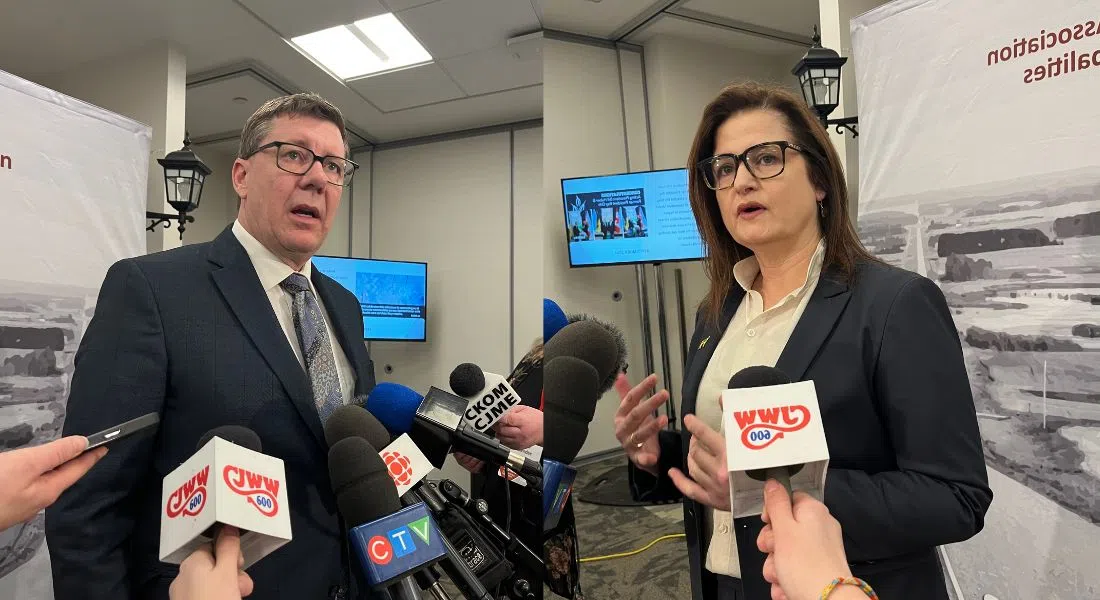
At the Saskatchewan Association of Rural Municipalities convention this morning, Scott Moe stated that the situation changes too rapidly to impose any countermeasures quite yet.
“This is how quickly this is happening; We say yesterday the threat of an electrical tariff on Ontario power going into three states. We saw a response of a 25 or 50 per cent tariff increase to the (steel and aluminum) industry, and a phone call settled that down and ended the day where we started.”
When asked if there were plans in place to support the province’s steel and aluminum industries, as 25 per cent tariffs on the metals were implemented today by the United States, he says we can expect to see different, innovative job-saving measures go into effect in the days ahead.
Tariff Support Measures
Saskatchewan’s premier says next week’s provincial budget will not include specific measures to address the aftermath of Chinese tariffs on Canadian canola oil and meal.
When asked what support farmers can expect to see from the province following the implementation of these 100 per cent tariffs on March 20th, Moe alluded that the budget won’t speak to this issue.
Moe continued that these tariffs are a response to Canada’s 100 tariffs on Chinese electric vehicles, which he claims no one here is buying anyways.
“Make no mistake, 100 per cent tariffs on Canadian canola oil and meal exports, alongside the challenge that we’re seeing in the United States with the on and off tariffs on various products, it will decimate the canola industry in Saskatchewan immediately, in a matter of weeks, not months.”
He calls on the federal government to engage with the Chinese government, fight for canola producers, and find a path forward.
Budget Presentation
The leader of the province says although there won’t be any tariff-specific support measures included in next week’s budget, the promises he made during his throne speech from October will all be there and accounted for.
Premier Scott Moe assured that Wednesday’s budget presentation will focus on five main priorities: affordability, improved access to healthcare, safer communities, education funding and collaboration.
In regard to safer communities, he says the provincial government is focused on providing recovery opportunities for those who face substance addiction but also increasing the consequences for those who are bringing drugs into our communities.
Message to Carney
Premier Scott Moe shared his advice for incoming Liberal Leader Mark Carney at the Saskatchewan Association of Rural Municipalities convention this morning.
Moe says he expects either a phone call or a sit-down conversation with Carney following his inception, where he would then share this message:
“Canadians need to know what the plan is on how you are going to engage with our largest trading partner, the United States of America, and across the board counter tariffs are simply going to hurt Canadians. Second, how are you going to engage on a very urgent and looming issue that is going to impact one of the largest agricultural commodities we export.”
He’s referring to China’s 100 per cent tariffs on Canadian canola oil, meal, and peas, and 25 per cent tariffs on pork and aquatic projects that are supposed to take effect March 20th.
Moe’s final tip for Carney is to keep his campaign promises, including the removal of the Carbon Tax.
Ten-dollar-per-day Childcare
As both childcare providers and parents worry about the future of $10 per day childcare, Saskatchewan’s Premier says the province will likely be resigning the federal government’s offer.
On Thursday, Ottawa announced it would be extending the Early Learning and Child Care program to all provinces for another 5 years. Saskatchewan and Alberta have yet to accept the offer.
Scott Moe says Saskatchewan focus, when it comes to childcare, is to expand the number of available spaces across the province. In negotiations with Ottawa, he wanted to ensure that that vision was met before signing on.
“We’re in those negotiations. We weren’t able to complete those negotiation in the two-week timeline that the federal government gave the provinces, but we expect to sign on, and we will sign on as soon as we’re able to have all our initiatives and questions we have addressed by the federal government.”
The current agreements expire on March 31st, 2026.
NDP Leader Shares Plan for Canada’s Future
Later in the convention’s agenda, NDP Leader Carla Beck called for a nationwide plan to build Canada’s future with more rail lines, pipelines and power lines.
She also wants the TransCanada Highway twinned from coast-to-coast. She told the SARM convention crowd that the ongoing trade war with U.S. President Donald Trump should serve as a “wakeup call” for all Canadian political leaders to get Canada’s products to tidewater, to access new trade markets and diversify the economy.
“This isn’t about politics. This isn’t about ideology. This is simply a must-do to meet the challenge and plan for the future of this country.” Beck says, “With federal and provincial budgets coming in just a few weeks, we must see movement – some of the initial building blocks – to set these future-focused infrastructure projects in motion. ”
She also spoke about lower commodity prices in her address at the SARM convention.
“The impacts of the threats and uncertainty are already having a devastating impact in this province. We’ve seen a $1000-a-head hit to feeder cattle, huge impacts to canola, and further devastating threats with the Chinese tariffs”
The NDP’s four-point plan to build Canada:
– Expansion of Rail and Port Capacity – Upgrading rail lines, including short-line rail, to ensure Saskatchewan’s agricultural and mining exports can efficiently reach overseas markets.
– A Pipeline to the East Coast – Constructing critical infrastructure to deliver Saskatchewan and Alberta oil and gas to European markets while alleviating pressure on rail transport.
– Strengthening Power Transmission – Investing in power generation and interties to secure electricity supply and position Saskatchewan as a leader in energy production.
– Twinning Highway 1 from Coast to Coast – Ensuring the efficient movement of goods within Canada without reliance on U.S. trade routes.